
Legacy of German Architecture’s in Georgia’s Capital
Germany holds a special place in Georgian history. It is such a broad and rich topic that not just one blog—or even one or two books—would be enough to cover it fully. Still, I will try to summarize a few stories that may be interesting not for historians or researchers, but for first-time visitors from Germany who come to Georgia as tourists. After hiking in the mountains, they may want to learn a bit more about the history of the city and the country they are discovering.
Of course, no visitor can avoid Rustaveli Avenue. Walking along it is a pleasant experience. Before moving to the main subject, it is worth repeating that Germany has always been a very special country for Georgia—consistently in a positive way throughout our history.
It all began in 1817, when the first group of German Swabians from Württemberg arrived in Georgia and founded settlements in Tbilisi and other towns. The reasons for their migration were varied, including religious and economic factors, though I will not go into detail here. Since 1801, Georgia had been part of the Russian Empire, and the emperor promised favorable conditions to settlers. Initially, around 3,000 Germans lived across different regions of Georgia, including Tbilisi. They brought elements of European culture with them—beer-making traditions, potatoes, and even cow’s milk, while Georgians had traditionally preferred buffalo milk and related products.
In the 1930s, during the Soviet period and around the time of World War II, approximately 23,000 Germans were deported from Georgia to Central Asia and Siberia.
This brief background helps us move toward the main topic. It may come as a surprise that there are very few capitals in the world where a central avenue was largely shaped by German architects—and Tbilisi is one of them.
Let’s take a walk along Rustaveli Avenue, from Rustaveli Metro Station to Liberty Square.
One of the first impressive buildings you will see is the Tbilisi Opera House,

Rustaveli ave #25 rebuilt in 1896 by the architect Viktor Johann Gottlieb Schröter (1839–1901). His parents migrated from Wittenberg to St. Petersburg. He graduated from the Academy of Arts in St. Petersburg and also studied in Berlin. From the 1860s, he worked in Tbilisi and is best known for his work on the opera house.
As you continue walking, you will encounter another notable building designed by the German architect Albert Salzmann (1833–
1897). Military Museum, today the National Gallery (Rustaveli Avenue #11).

He was born in Tbilisi into a Swabian migrant family and studied at the Academy of Arts in St. Petersburg. Salzmann designed many distinguished buildings in Tbilisi. He was buried in the German Lutheran cemetery in Kukia, which unfortunately no longer exists.
Directly opposite the National Gallery stands another impressive building—Tbilisi’s First Classical Gymnasium (Rustaveli Avenue #10),
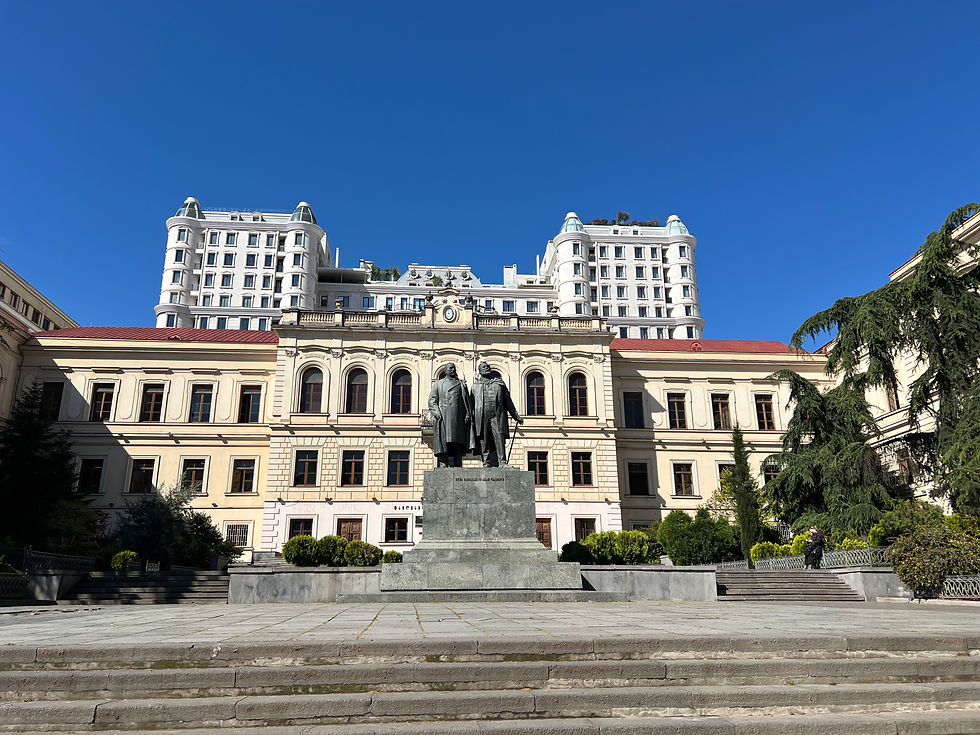
designed by Otto Jakob Simonson. He was born in Dresden in 1829 and worked in Tbilisi from 1859 to 1909. He designed many significant buildings, including churches and private residences for wealthy Tbilisi families. In 1909, he moved to Riga, where he passed away in 1914.
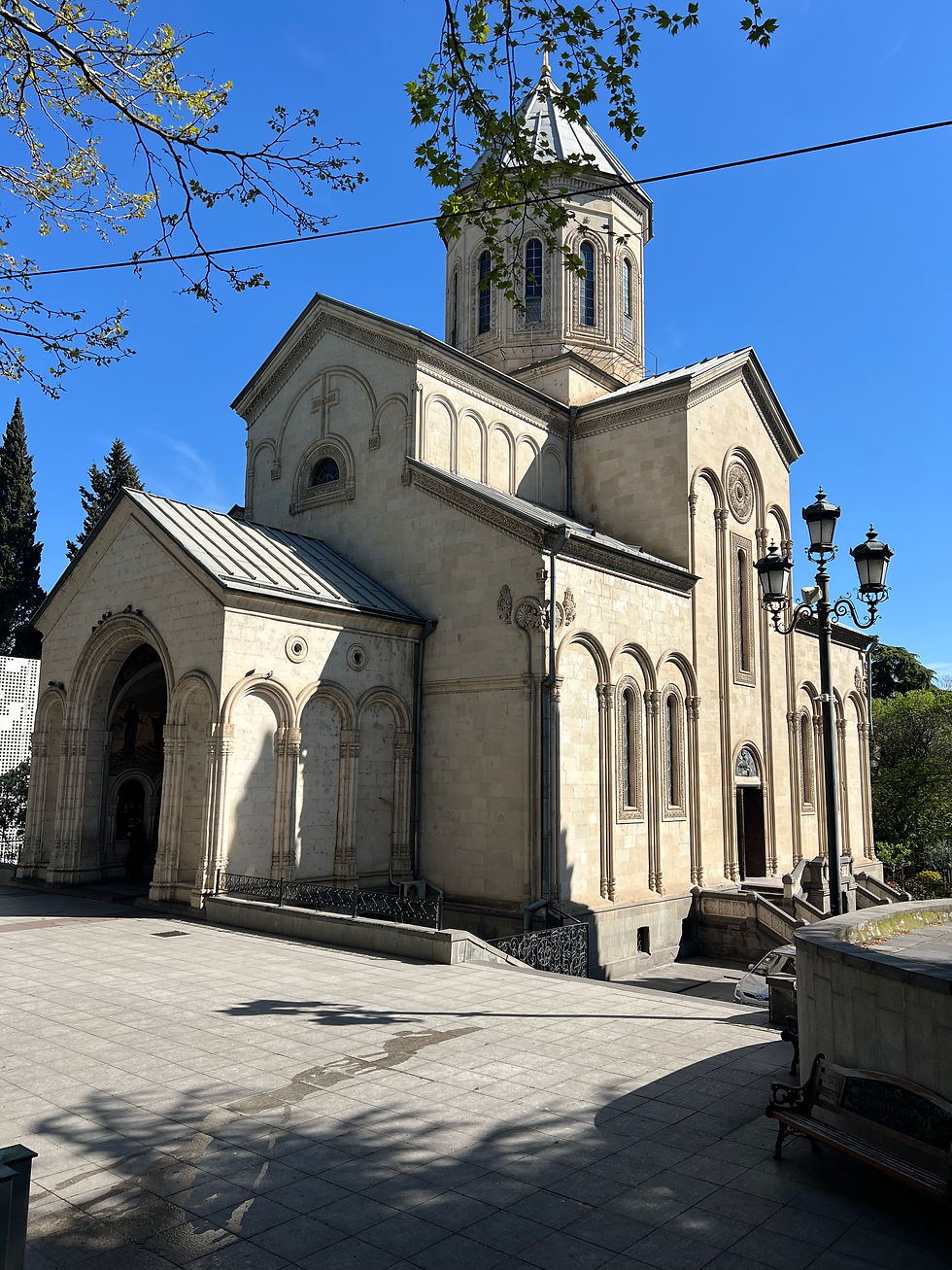
At Rustaveli Avenue #9 stands Kashveti St. George Church, designed by Albert Salzmann and Otto Simonson.
Further along, the former Viceroy’s Palace (today the National Youth Palace, Rustaveli Avenue #6) was redesigned by Otto Simonson in 1870–71, who gave the building its current façade.

Finally, at Liberty Square, the current Tbilisi City Council building was redesigned by the German architect Paul Stern. He added a third floor to the central part of the building, giving it a stepped silhouette. He also replaced the existing fire tower with a taller, gazebo-like Rathaus tower crowned with a clock. The façade was decorated with Moorish elements according to his design.

What I have described above is mostly focused on the 19th century, but Germans also have many important stories in 20th-century Georgia, which I will continue exploring in another blog.
Mukhran Guliashvili
Used sources


Comments